JOHN LENNON: THE SOLDIER, THE DREAMER, AND THE ENDURING SPIRIT OF A GENERATION
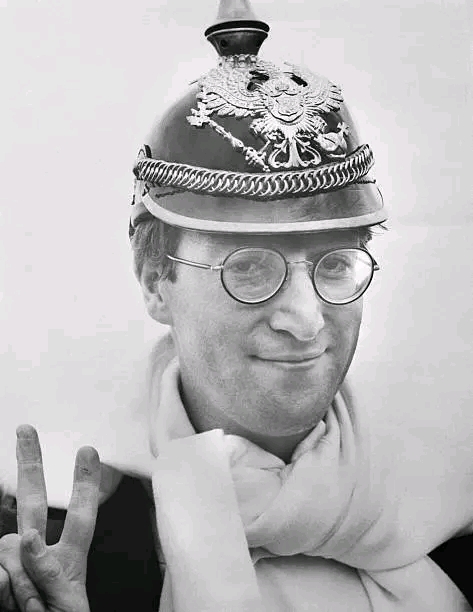
In 1967, during a brief pause between recording sessions and cultural revolutions, John Lennon stepped into a different kind of spotlight. Far from the roar of Beatlemania, he found himself in the deserts of Spain filming How I Won the War, portraying the bespectacled Private Gripweed—awkward, sardonic, and unmistakably Lennon. The film itself was an anti-war satire, but even in its absurdity, Lennon’s presence glowed with a curious energy: sharp-witted, restless, and brimming with that intangible magnetism that made him impossible to overlook.
Behind the signature glasses, behind the sarcastic delivery, Lennon carried a depth audiences could sense even when he wasn’t singing. There was always something more in his eyes—humor dancing with vulnerability, rebellion tangled with yearning. How I Won the War captured a rare moment where Lennon, stripped of the Beatles’ roar, let the world glimpse the man behind the myth.
But the world’s fascination with him would soon be matched by sorrow. On December 8, 1980, outside the Dakota in New York City, Lennon’s extraordinary life was cut short at the age of 40. The news was a shock that rippled across continents. Streets filled with silent crowds. Radios paused their programming to play “Imagine.” Fans lit candles in windows, gathered in parks, and held each other as if mourning a friend they had never met but deeply knew.
Even President Jimmy Carter stepped forward to honor the fallen artist, saying:
“His spirit, the spirit of the Beatles—brash and earnest, ironic and idealistic all at once—became the spirit of a whole generation.”
It was a tribute that captured what millions felt: Lennon wasn’t just a musician; he was a symbol of possibility.
Throughout his life, he embodied contradictions that made him compellingly human. He was playful yet philosophical, rebellious yet tender, sharply critical yet endlessly hopeful. His music carried protest and poetry, rage and healing, cynicism and idealism—often within the same verse. Lennon didn’t just write songs; he exposed his heart, flaws and all, trusting the world to make sense of the pieces.
Films, interviews, drawings, political activism, love letters—everything he touched bore that same spark of honesty. He refused to stay quiet, refused to conform, refused to stop dreaming, even when the world pushed back.
And that is why, decades after his passing, John Lennon’s voice still resonates.
He remains more than a Beatle, more than a rock legend. He is a cultural compass—guiding generations toward peace, imagination, and the courage to question the world. Every time someone whispers “All you need is love,” every time “Imagine” drifts through a quiet room, every time a young artist picks up a guitar searching for truth, Lennon lives on.
The soldier in How I Won the War is long gone.
The dreamer he became never will be.