George Harrison: The Quiet Beatle’s Spiritual and Musical Legacy
Among the towering personalities of The Beatles, he was often described as “the quiet one.” Yet the legacy of George Harrison speaks louder with each passing generation. As lead guitarist of the most influential band in popular music history, Harrison not only shaped the sound of the 1960s but also helped introduce Western audiences to Indian spirituality, philosophy, and music. His journey from Liverpool schoolboy to global spiritual icon remains one of rock’s most fascinating transformations.
Early Years and Musical Growth
Born in Liverpool in 1943, Harrison joined The Beatles as a teenager, recruited by Paul McCartney to play lead guitar alongside John Lennon. In the band’s early years, Lennon and McCartney dominated songwriting, while Harrison refined his craft quietly in the background. His sharp, melodic guitar lines became a defining feature of early hits, giving songs their distinctive edge.
By the mid-1960s, Harrison began emerging as a songwriter in his own right. Tracks like “If I Needed Someone” hinted at his growing confidence, but it was later compositions such as “While My Guitar Gently Weeps,” “Something,” and “Here Comes the Sun” that proved his brilliance. “Something,” in particular, became one of the most celebrated love songs ever written, admired even by artists like Frank Sinatra.
The Spiritual Awakening
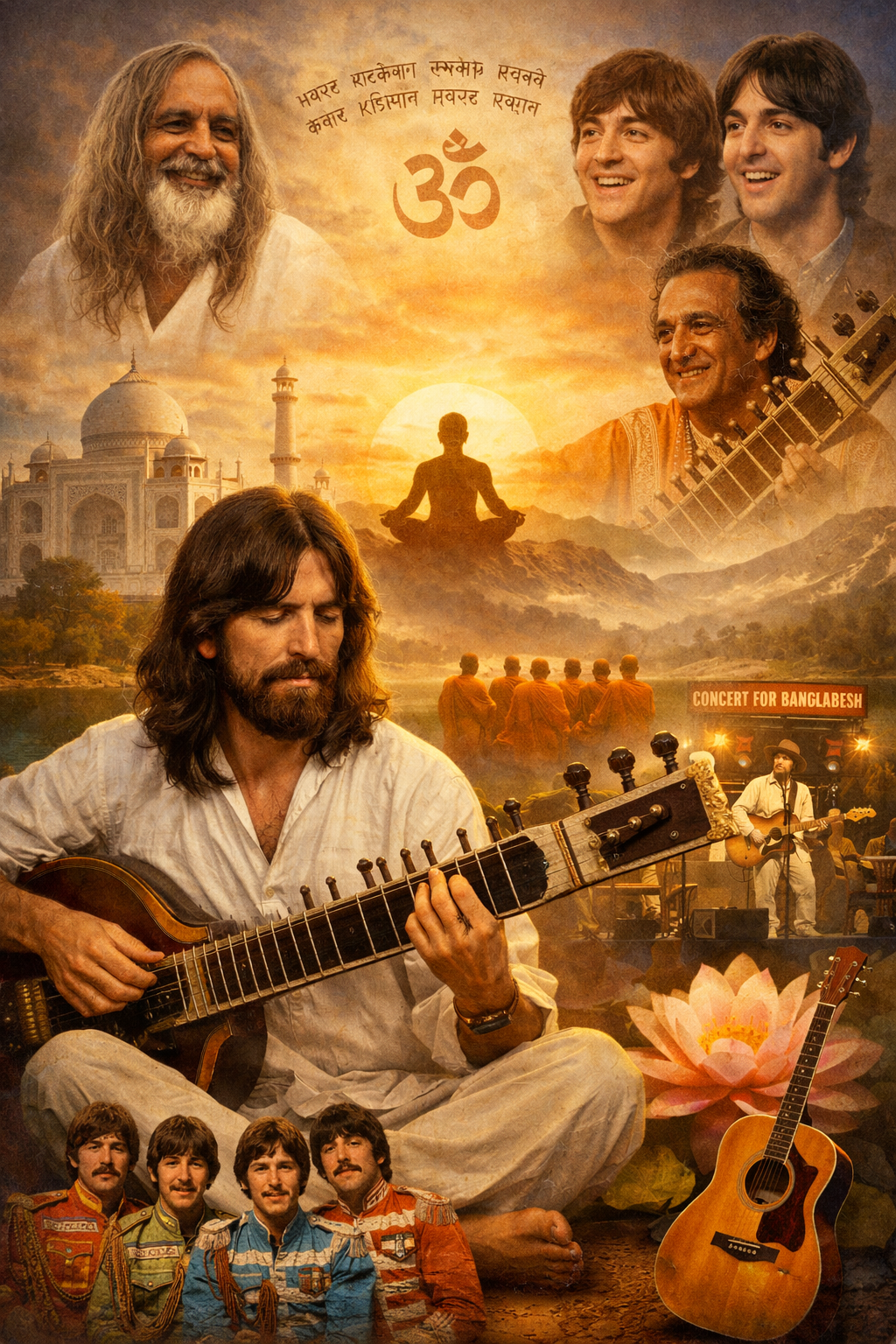
Harrison’s life changed dramatically when he discovered Indian music and philosophy. His fascination with the sitar, guided by legendary musician Ravi Shankar, led him to study classical Indian traditions deeply. This influence first appeared in Beatles songs like “Norwegian Wood,” marking one of the earliest uses of Indian instruments in Western rock music.
In 1968, Harrison and his bandmates traveled to Rishikesh to study Transcendental Meditation under Maharishi Mahesh Yogi. Although their time there was mixed with controversy and eventual disillusionment for some members, Harrison’s spiritual search endured. He embraced Hindu philosophy, chanting, and devotional practices, weaving these themes into his music for the rest of his life.
His solo hit “My Sweet Lord” openly expressed his devotion, blending Western pop with the Hindu mantra “Hare Krishna.” At a time when spirituality in rock was still rare, Harrison boldly placed faith at the center of mainstream music.
Post-Beatles Brilliance
When The Beatles disbanded in 1970, Harrison surprised critics with the monumental triple album All Things Must Pass. It showcased a treasure trove of songs he had accumulated during his Beatles years. The album’s success established him as a major solo artist, not merely a former band member stepping out of a shadow.
In 1971, Harrison organized the groundbreaking Concert for Bangladesh, one of the first major charity concerts in rock history. Collaborating again with Ravi Shankar, he mobilized global superstars to raise funds and awareness for refugees. This event set a template for future benefit concerts such as Live Aid, demonstrating how music could serve humanitarian causes.
The Quiet Strength
Despite his global fame, Harrison remained introspective and often avoided the spotlight. He valued privacy, spirituality, and authenticity over celebrity culture. While Lennon was outspoken and McCartney relentlessly ambitious, Harrison offered balance — a contemplative voice within a cultural revolution.
His guitar style also left a lasting mark. Rather than flashy solos, he favored tasteful, melodic phrasing that served the song. This approach influenced generations of guitarists who learned that restraint can be as powerful as virtuosity.
Enduring Legacy
When George Harrison passed away in 2001, tributes poured in from across the music world. Yet his legacy extends beyond awards and chart positions. He broadened Western awareness of Eastern spirituality, integrated world music into rock, and demonstrated that inner exploration could coexist with global stardom.
Today, songs like “Here Comes the Sun” continue to resonate with new listeners, offering warmth, hope, and quiet optimism. Harrison may have been “the quiet Beatle,” but his voice — spiritual, melodic, and deeply human — remains one of the most powerful echoes of the 20th century.
In the grand story of The Beatles, George Harrison stands not in the background, but as a bridge — between East and West, fame and faith, sound and silence.