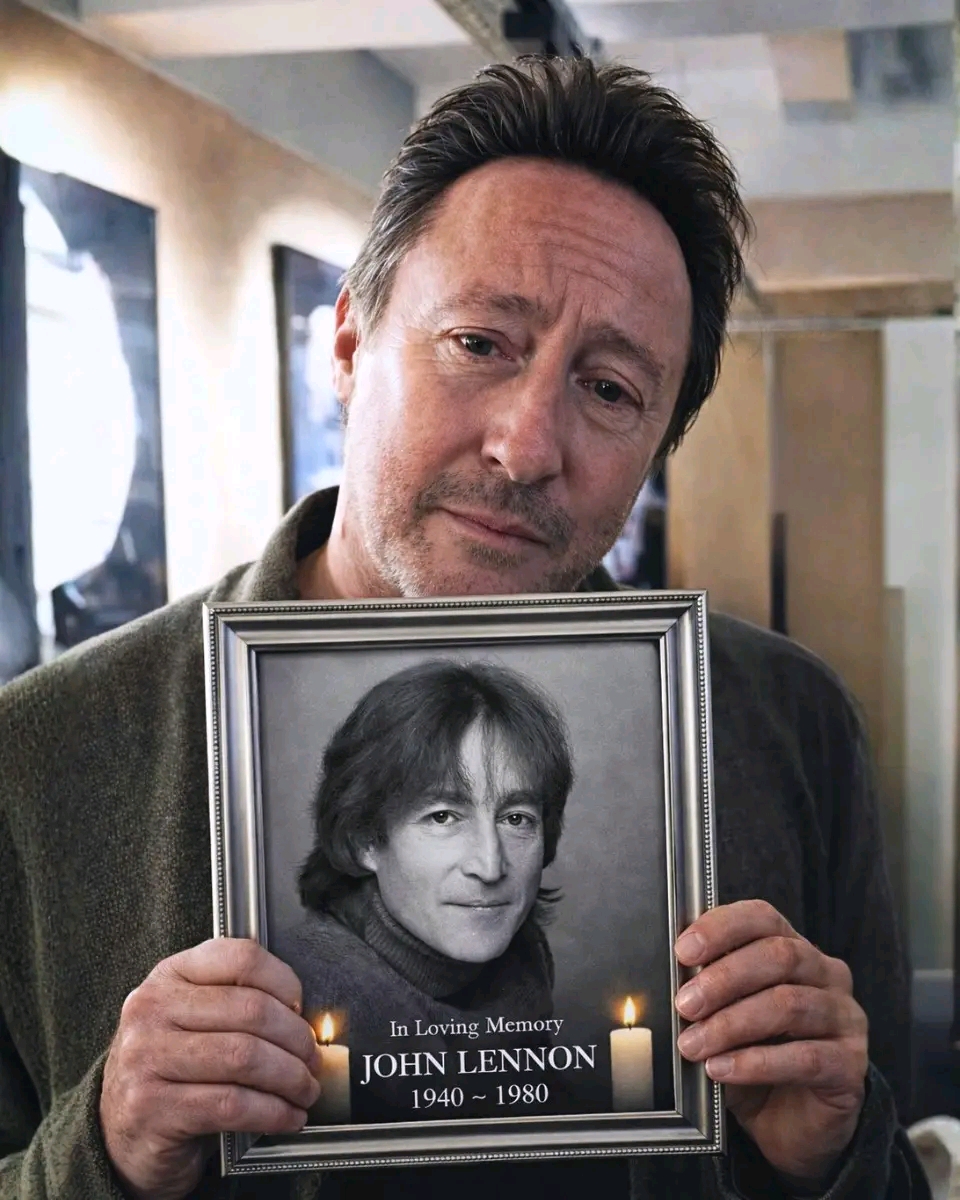
Julian Lennon and the Quiet Grief Behind a Global Tragedy
When John Lennon was killed on the night of December 8, 1980, outside The Dakota, the shock rippled across the world instantly. Radios began playing his songs through the night. Fans gathered in silent crowds, holding candles and singing the music that had shaped a generation. For millions, it felt like the loss of a voice that had spoken to their hopes, fears, and dreams.
But for Julian Lennon, the tragedy was not cultural or symbolic. It was deeply personal.
He was just seventeen years old.
Grief at that age is confusing even under ordinary circumstances. For Julian, it unfolded in the shadow of worldwide mourning. The world saw his father as a legend, a revolutionary musician, and a voice for peace through his work with The Beatles and his solo career. Julian, however, was grieving something more intimate: a complicated father-son relationship that had been shaped by distance, admiration, and unanswered questions.
In the earliest hours after the tragedy, Julian reportedly learned of his father’s death through media reports rather than a direct call from family. That moment underscored the isolation he felt during one of the most devastating events of his life. While headlines raced around the globe, a son struggled quietly to process the loss.
His grief carried many layers. There were warm childhood memories from the years when his parents, John and Cynthia Lennon, were still together. There were also years of separation after his father’s life moved in a different direction with Yoko Ono. Like many children of divided families, Julian had grown up with mixed emotions—love, confusion, admiration, and longing.
Perhaps most painful was the possibility that time might have healed some of those distances. As Julian approached adulthood, there was hope that their relationship could evolve, that they could understand one another more fully. John’s sudden death ended that possibility forever. When someone dies unexpectedly, the chance for reconciliation disappears without warning, leaving conversations unfinished.
In the years that followed, Julian tried to process that grief through music. His debut album, Valotte (1984), introduced him to the world as an artist in his own right. Yet from the beginning, critics and listeners compared his voice and style to his father’s. Some heard echoes of John Lennon’s tone and phrasing. For Julian, every song carried a dual burden: expressing his own identity while inevitably being measured against one of the most famous musicians in history.
Living with such comparisons was not easy. He was not just the son of a legend—he was also a young man trying to define himself while carrying the emotional weight of his father’s absence.
Over time, Julian spoke more openly about those complicated feelings. He acknowledged the hurt of the past, but also the enduring love he felt for his father. His reflections became more balanced with age, marked by a calm understanding rather than bitterness. The anger softened, though the longing never entirely disappeared.
Today, the world remembers John Lennon as one of the most influential musicians of the twentieth century—a cultural icon whose songs continue to inspire millions.
But for Julian Lennon, the memory is far simpler and far more human.
The world remembers a legend.
He remembers Dad. 🕊️


