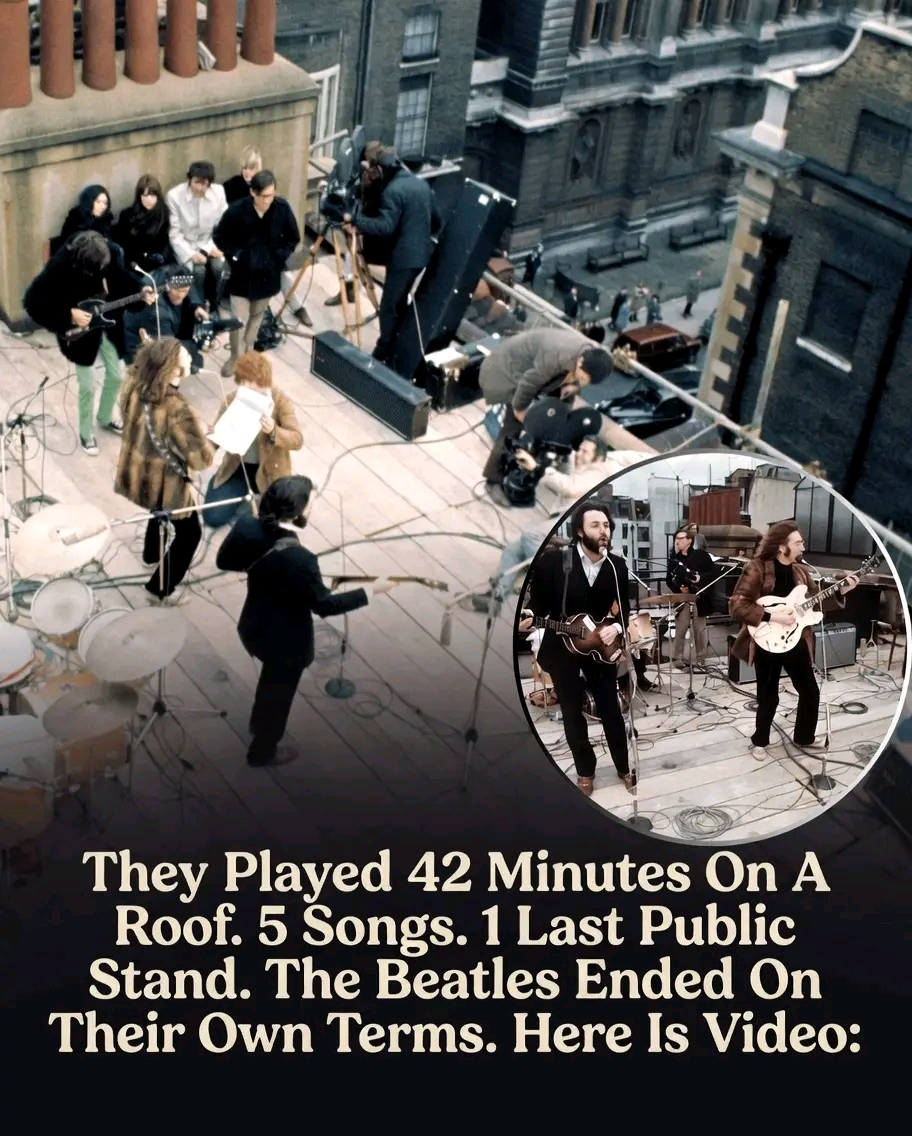
On January 30, 1969, high above the busy streets of London, The Beatles delivered what would become their final public performance—an unannounced, unforgettable rooftop concert that lasted just over 40 minutes but echoed through music history for decades.
The setting was the rooftop of Apple Corps headquarters. There were no tickets, no promotion, and no stage lights—just four musicians, a handful of crew members, and the cold winter air. What began as an idea to bring energy to the filming of their upcoming project, Let It Be, quickly turned into something far more meaningful.
As John Lennon, Paul McCartney, George Harrison, and Ringo Starr launched into songs like “Get Back,” “Don’t Let Me Down,” and “I’ve Got a Feeling,” the sound drifted down into the streets below. Office workers paused, pedestrians gathered, and confusion quickly turned into amazement as word spread—The Beatles were playing live, right above them.
It wasn’t a polished concert. There were missed notes, laughter between takes, and visible tension lingering from months of internal strain. Yet that rawness is exactly what made the performance so powerful. It felt real, unfiltered—a rare glimpse into a band that had changed the world, now standing at the edge of its final chapter.
As the crowd grew, so did the attention from local authorities. The performance was eventually cut short when police arrived, concerned about noise and disruption. But even as they were asked to stop, the band kept playing, squeezing every last moment out of their impromptu stage.
In many ways, the rooftop concert was more than just a performance—it was a quiet act of defiance and a symbolic farewell. Rather than announcing their end with a formal goodbye, The Beatles chose spontaneity. No grand arena, no global broadcast—just music, played live, one last time in public.
Their closing moments captured that spirit perfectly. After finishing “Get Back,” John Lennon famously signed off with a touch of humor and irony, thanking everyone “on behalf of the group and ourselves,” a line that felt both lighthearted and final.
Within a year, The Beatles would officially break up. But on that cold London rooftop, none of that had been declared yet. Instead, what the world witnessed was something far more poetic—a band that had redefined music stepping into the unknown, leaving behind a performance that felt both like a return to their roots and a farewell without words.
For 42 minutes, above the noise of the city, The Beatles reminded everyone why they mattered. And then, just like that, it was over—leaving behind one of the most iconic final acts in the history of popular music.