THE QUIET WALK HOME — The Photograph That Captured John Lennon’s Happiest Disappearing Act
There are no bodyguards in this story.
No screaming fans, no limousines, no reporters jogging backward with a microphone in hand.
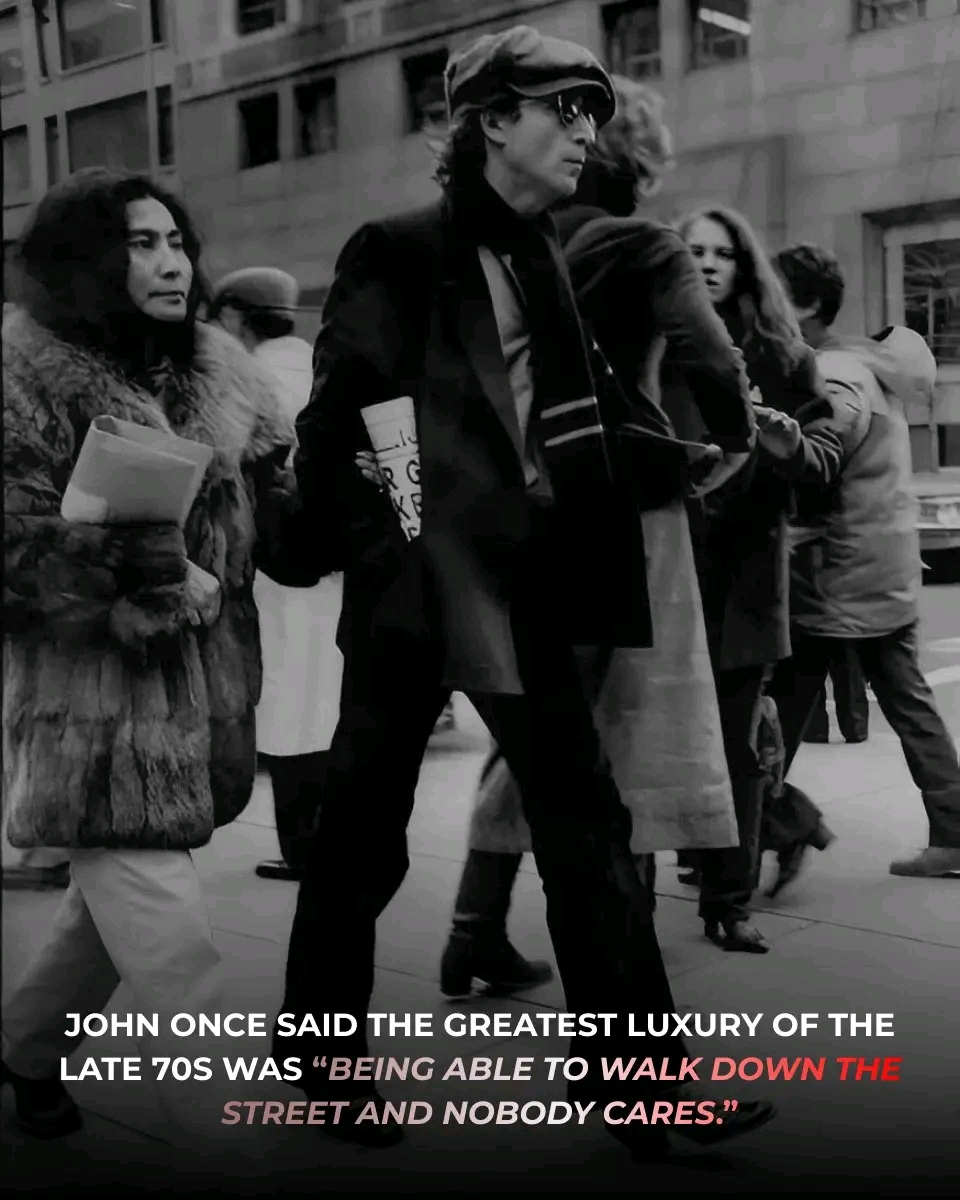
Just a cold Manhattan afternoon in 1978, a stretch of 72nd Street, and a man who once changed the world quietly carrying a folded newspaper.
They’re walking east, only a few steps from the Dakota archway. John Lennon — the face of a revolution, the voice of a generation — looks almost like a ghost of himself, or perhaps the most real version he ever became. He’s wrapped in a long black overcoat bought in London years earlier, a poet’s silhouette against the winter wind. His beret sits low, scarf coiled around his neck, dark glasses hiding the famous eyes that once launched a thousand headlines. In his hand, a rolled-up New York Post: the day’s noise, reduced to something he’d toss on the kitchen counter.
Yoko walks just behind him, a fur coat around her shoulders, boots tapping rhythmically on the pavement. Her hair blows wild in the wind, one hand gripping a manila envelope overflowing with the unglamorous paperwork that keeps a household upright — contracts, proofs, immigration forms, business documents. She was the engine behind their life; John was the one rediscovering what it meant to simply live.
There is nothing dramatic about this scene.
And that is precisely what makes it extraordinary.
By 1978, the press had nearly stopped looking for them.
No new scandals, no radical statements, no abrupt disappearances. The circus that had once followed them like a permanent shadow had drifted on to newer, louder stories. Most outsiders assumed John Lennon had faded out, retired, or simply stopped caring.
They didn’t know the truth: he was happier than he had been in years.
This was John’s “househusband” era, the years he woke at 4 a.m. to bake bread, learned the rhythms of fatherhood, experimented with recipes, dabbled in calligraphy, played music only when he felt like it. Yoko ran the business side — the finances, decisions, meetings — while John ran the nursery and the kitchen. He wasn’t hiding. He was healing.
The man who once couldn’t step outside without a crowd now treasured the absurd pleasure of being ignored.
“Being able to walk down the street and nobody cares,” he said, “that’s the greatest luxury.”
This photograph — candid, quiet, almost unimpressive — proves he had finally earned that luxury.
No one stopped them. No one took notice. They were simply two people in their late thirties heading home after an errand, wrapped in coats against the cold, thinking about dinner, routine, and the small domestic joys they had fought so hard to build.
Two years later, the world would lose John Lennon, and everything quiet about him would vanish under a tidal wave of grief, tributes, and retrospective myth-making. The gentle ordinariness of this moment would be swallowed by the legend.
But the photograph remains.
A fragile time capsule of a man at peace.
A reminder that after surviving fame, chaos, addiction, breakups, separations, deportation threats, and the implosion of the greatest band in the world… John Lennon found his happiness not in applause, but in anonymity.
It may be one of the happiest images ever captured of him.
And almost no one noticed it at the time — which is exactly why he loved it.