They Didn’t Ask Permission — They Changed the Rules Instead
For years, the story of the Beatles’ evolution has been told as a sequence of albums, hairstyles, and cultural moments. But when Paul McCartney reflects on the band’s most radical turning point, he doesn’t describe it as a bold announcement or a calculated revolution. He describes it as something quieter — a moment when pop music simply stopped playing it safe and stepped into the unfamiliar without asking whether it was allowed to be there.
In the mid-1960s, popular music still operated within invisible boundaries. Songs were meant to be short, melodic, and easily digestible. Experimentation existed, but it lived on the fringes — in avant-garde studios, academic halls, and underground scenes far removed from the charts. The unspoken rule was simple: pop could borrow a little color, but it shouldn’t challenge the listener too deeply. The Beatles, almost accidentally at first, decided to ignore that rule.
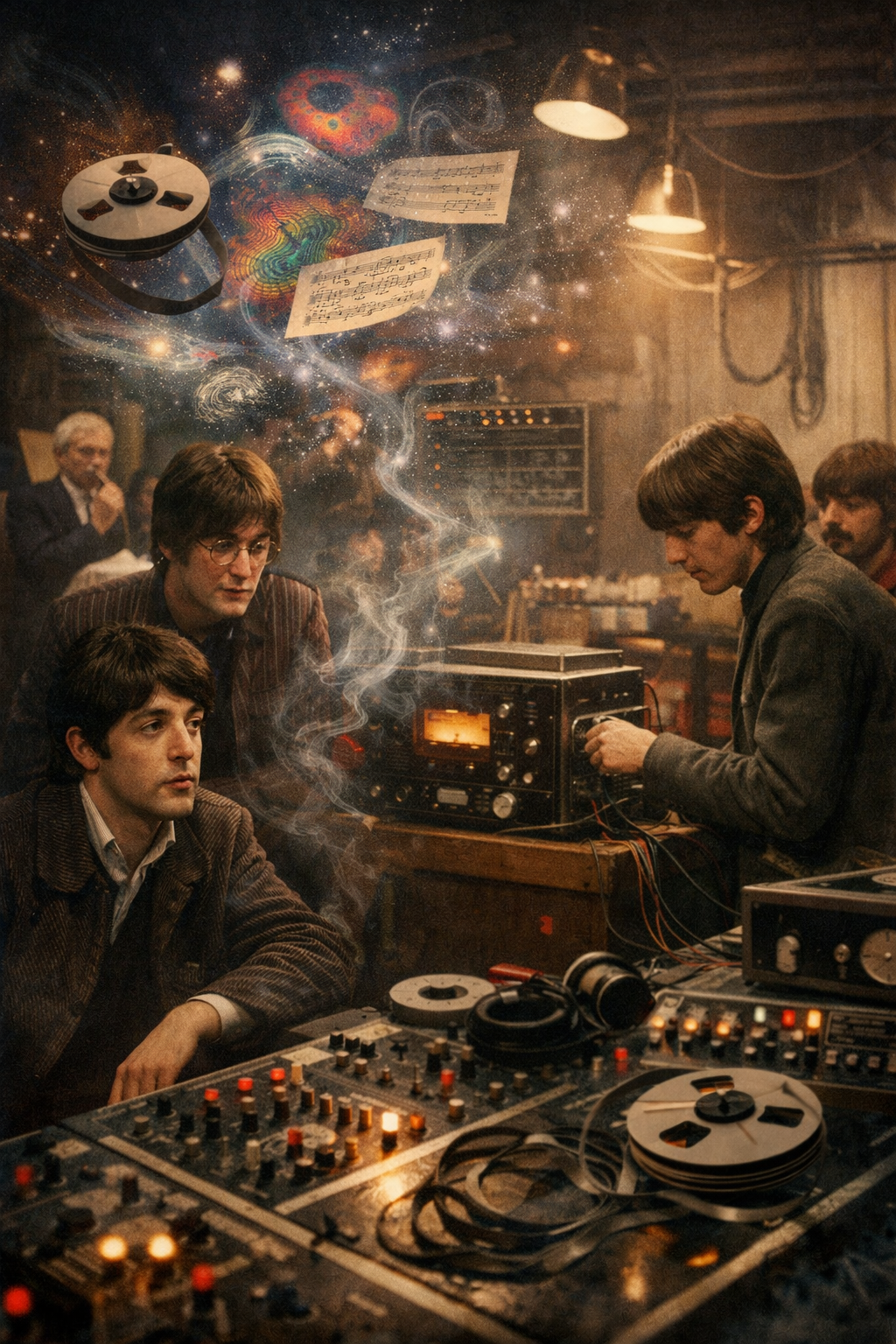
What makes McCartney’s reflection so striking is that there was no grand manifesto behind the shift. No guarantee that audiences would stay. No roadmap explaining how far was too far. There were only curiosities: tape loops spinning endlessly on machines, snippets of radio static bleeding into sessions, and ideas lifted from experimental composers whose names most fans would never know. Instead of asking whether people would understand, the Beatles trusted that listeners might feel something — even if they couldn’t immediately explain it.
At the time, it sounded dangerous. Even reckless. Pop stars weren’t supposed to embrace randomness, abstraction, or sonic confusion. Yet songs like “Tomorrow Never Knows” didn’t arrive as academic exercises; they arrived wrapped in rhythm, repetition, and atmosphere. The unfamiliar wasn’t presented as difficult — it was presented as immersive. The band didn’t explain what they were doing. They simply did it and let the audience catch up.
McCartney later admitted that there was a quiet decision being made behind the scenes: the belief that listeners were more open-minded than the industry gave them credit for. This wasn’t experimentation for its own sake. It was an act of faith. The Beatles weren’t trying to alienate their audience; they were inviting them forward, step by step, into new terrain — trusting that curiosity would outweigh fear.
Once that invisible line was crossed, pop music could never return to its earlier limits. Suddenly, chart-topping artists were allowed to sound strange. Albums could be experiences rather than collections of singles. Studios became instruments, not just recording rooms. The audience, having followed once, was willing to follow again — further each time.
What’s remarkable is how little resistance there was in hindsight. Millions crossed that line without realizing it had been crossed at all. A generation absorbed experimental techniques not as theory, but as emotion. Tape loops became hypnotic. Drones became meditative. Unusual structures became familiar. The rules didn’t disappear — they were rewritten.
McCartney’s reflection reframes the Beatles not as rebels shouting against tradition, but as explorers quietly extending the map. They didn’t ask permission because permission wasn’t the point. They believed pop music could carry complexity without losing its soul — and they trusted the listener to meet it halfway.
That trust changed everything. It reshaped not only rock, but the very idea of what mainstream culture could contain. Today, when experimentation is expected and genre boundaries blur freely, it’s easy to forget how fragile that moment once felt. But there was a time when pressing “record” on something unfamiliar meant risking everything.
The Beatles took that risk without fanfare. And in doing so, they proved that audiences don’t need to be protected from new ideas — sometimes, they’re waiting for them.