OTD in ’67 — The Night Paul McCartney and George Harrison Quietly Changed Course
In the restless summer of 1967, when London pulsed with color, protest, and possibility, Paul McCartney and George Harrison did something surprisingly ordinary. They slipped anonymously into a small London concert hall to watch their friend Donovan perform live. No entourage. No announcement. Just two Beatles sitting in the dark, listening. At the time, it felt like an evening off — a pause from Sgt. Pepper’s aftershocks and the weight of being the most famous musicians on earth. In retrospect, it was something else entirely: a quiet ignition point that would follow them across continents and into one of the most intimate chapters of their creative lives.
Donovan’s performance that night was stripped of spectacle. His guitar style leaned heavily on fingerpicking traditions drawn from folk and blues, but filtered through a gentler, more meditative sensibility. Paul, always alert to melodic economy, was struck by how a single acoustic guitar could carry rhythm, harmony, and emotion all at once. George, already drifting away from pop stardom toward spiritual and musical exploration, heard something deeper — a sound that felt inward-looking, almost devotional. Neither man knew it yet, but the seeds planted in that London room would resurface far from home.
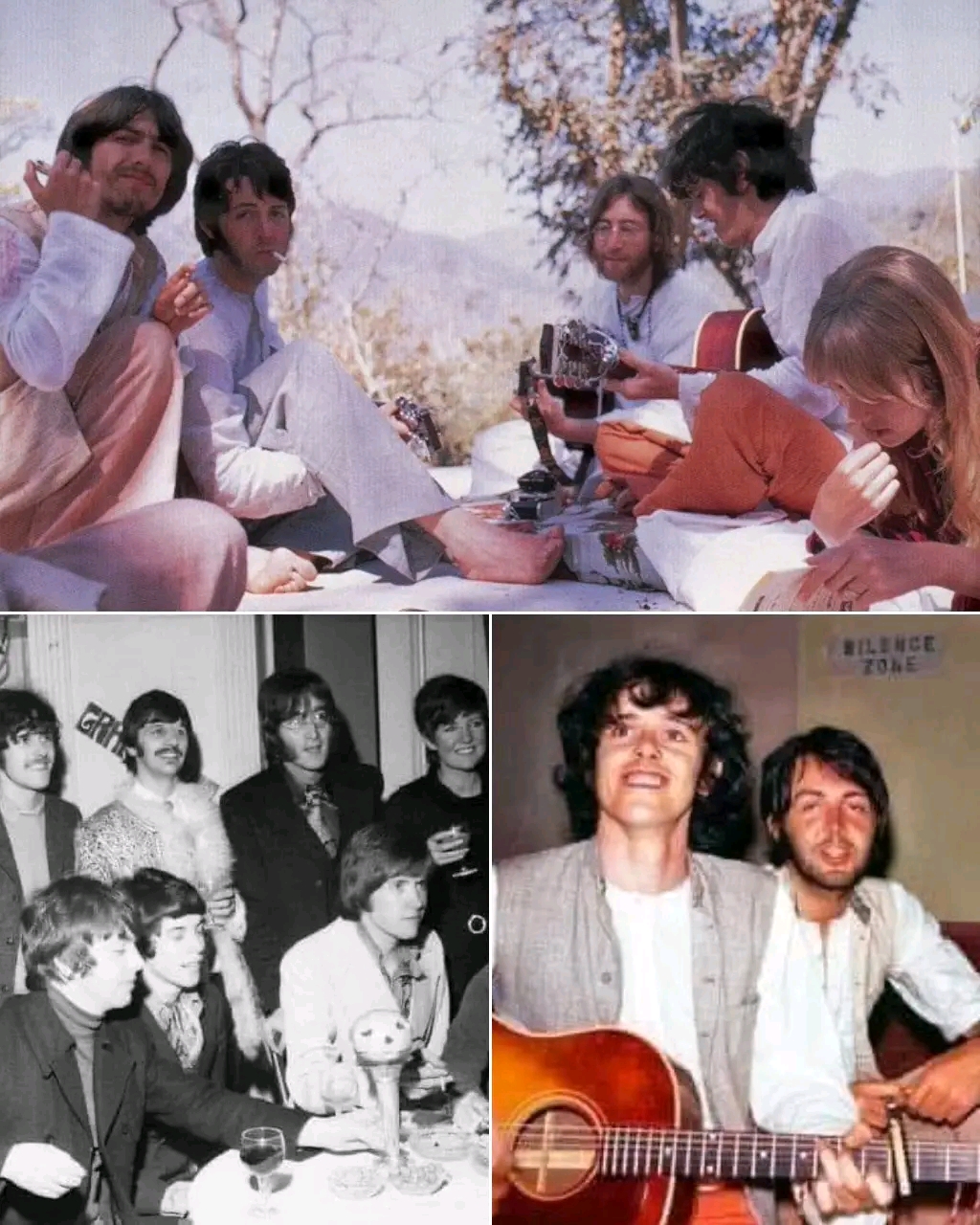
Only months later, those same seeds traveled with them to Rishikesh, India. In the ashram of Maharishi Mahesh Yogi, the Beatles stripped away the machinery of Beatlemania and returned to the essentials: wood, wire, voice, and silence. Donovan was there too, and in the downtime between meditation sessions, guitars were passed around like shared secrets. Donovan showed Paul a clawhammer-style fingerpicking pattern, emphasizing independence between thumb and fingers. It wasn’t a formal lesson — more like a conversation. But for McCartney, it unlocked a new way of thinking about the acoustic guitar as a complete orchestra.
The results surfaced most famously on “Blackbird.” Built almost entirely on that fingerpicking approach, the song feels private, as if overheard rather than performed. Paul’s guitar doesn’t merely accompany the melody — it is the melody’s shadow, walking alongside it in counterpoint. The influence is unmistakable, yet transformed. What began as a folk technique became something uniquely McCartney: precise, lyrical, and emotionally transparent.
George Harrison absorbed the moment differently. For him, Donovan’s playing reinforced the idea that technique could serve contemplation rather than virtuosity. This philosophy echoed across The White Album, where George’s guitar work often favors space, texture, and restraint over flash. Songs like “Long, Long, Long” and his acoustic passages throughout the sessions reflect a guitarist listening inward, less concerned with dominating a track than with revealing a feeling.
What makes that 1967 concert so remarkable is its subtlety. No chart-topping single emerged directly from it. No interviews proclaimed its importance. Yet its influence lingers in the quiet corners of the Beatles’ late work — in the spaces between notes, in the confidence to be small after being enormous. It was a reminder, absorbed in the dark of a London hall, that growth doesn’t always announce itself loudly.
On this day in 1967, Paul McCartney and George Harrison didn’t just watch Donovan perform. They listened — deeply. And in doing so, they carried away a spark that would glow softly through India, through the White Album, and through some of the most personal music the Beatles ever made. Sometimes history changes not with a roar, but with the gentle sound of fingers on strings.