“I Never Wrote Them to Last Forever.” Paul McCartney, Memory, and the Quiet Weight of Songs
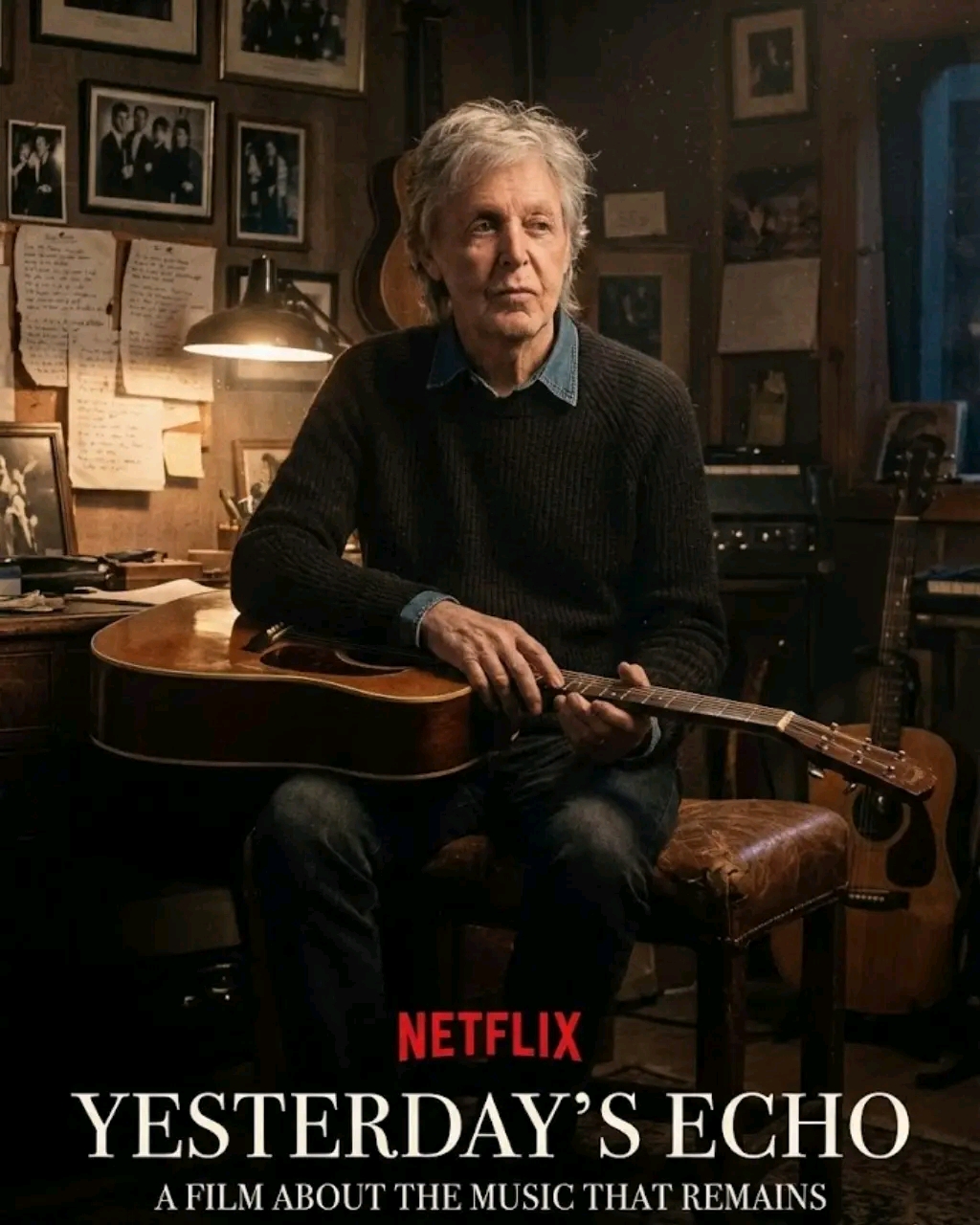
Paul McCartney has spent most of his life being asked to explain miracles. How do songs like Yesterday, Let It Be, or Hey Jude arrive so fully formed? How does a man carry melodies that seem to belong to everyone? In a new Netflix documentary, quietly introduced without fanfare, McCartney does something rarer than nostalgia. He steps sideways—away from triumph—and back into the private rooms where the songs were born.
The trailer makes its intention clear. This is not a victory lap. There are no fireworks, no scoreboard of sales or stadiums conquered. Instead, the camera lingers on pauses. On breaths. On the spaces between words. McCartney, now speaking with the ease of someone who has stopped trying to impress history, looks back not to claim greatness, but to understand endurance.
“I never wrote them to last forever,” he says—almost offhand, almost apologetic. The line lands softly, yet it carries the weight of a lifetime. These songs were not designed as monuments. They were written for moments: a lonely night, a sudden melody upon waking, a phrase meant to comfort a child, a tune to survive a breakup, a loss, a fear of what comes next. And yet, here they are—still walking beside us decades later.
The documentary returns again and again to that contradiction. McCartney revisits familiar songs not as cultural artifacts, but as personal companions. He remembers where he was emotionally, not commercially. What he was afraid of. Who he missed. What he didn’t yet know how to say out loud. The music, he suggests, often arrived before understanding did.
What makes the film quietly powerful is its refusal to mythologize the process. Inspiration is not framed as lightning, but as listening—paying attention to ordinary feelings before they slip away. McCartney speaks about writing as survival, not ambition. Songs were how he processed grief, steadied himself after chaos, and found footing when the ground disappeared beneath him.
There is an unmistakable undercurrent of loss. Friends gone. Voices silenced. Chapters closed without warning. Yet the documentary doesn’t linger in sadness. Instead, it explores how music becomes a place where people continue to meet—across time, across absence. A song written in one lifetime can quietly accompany another through heartbreak, healing, or hope, without ever asking permission.
Netflix frames the story with restraint. The camera avoids spectacle, choosing intimacy over scale. We see McCartney not as a legend addressing an audience, but as a man in conversation with his past—sometimes smiling, sometimes unsure, often reflective. He does not claim to understand why the songs lasted. He seems, in many ways, surprised that they did.
That surprise may be the film’s most honest note. Longevity, McCartney suggests, wasn’t part of the plan. Meaning happened later, shaped by listeners who carried the music into weddings, funerals, hospital rooms, road trips, and long nights when sleep refused to come. The songs grew because people needed them to.
In one sense, the documentary becomes less about Paul McCartney and more about us. About how art travels beyond intention. About how something written quickly, gently, without expectation, can become a lifelong companion. McCartney’s reflections invite a larger question: if these songs were never meant to last forever, what does it say about the human need to hold onto them?
Perhaps the answer lies in the way he speaks—without certainty, without grand conclusions. The music, like memory, remains unfinished. It keeps changing as we do. It waits patiently until someone needs it again.
By the time the trailer ends, there is no crescendo, no declaration of legacy. Just a quiet understanding: that the songs weren’t built to endure time—but to endure people. And in doing so, they somehow learned how to outlive us all.