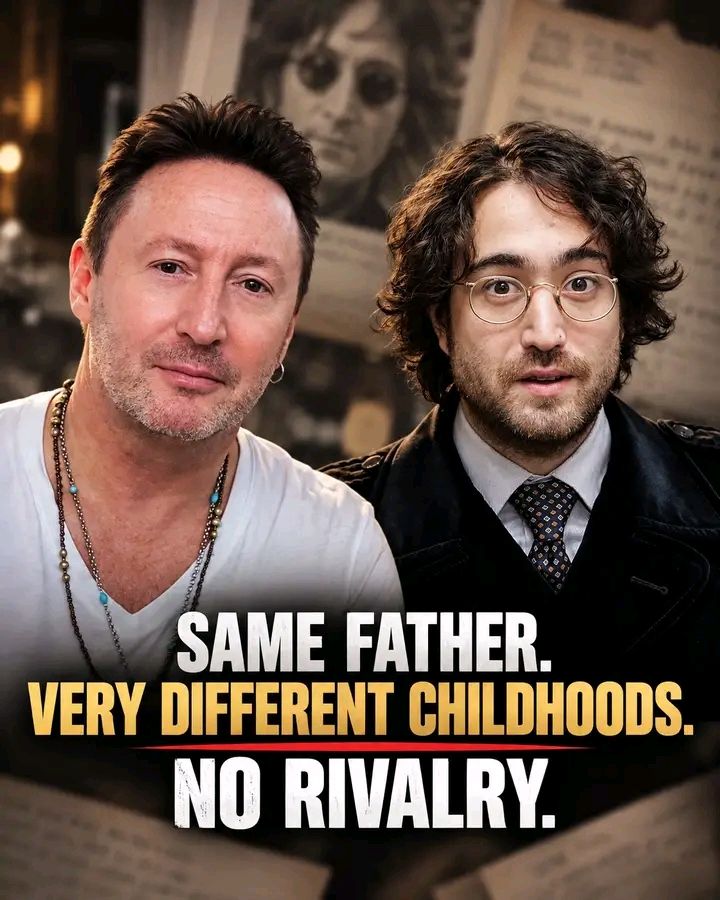
Julian and Sean Lennon: The Brothers Who Refused to Let Their Father’s Past Divide Them
John Lennon left behind one of the most powerful legacies in music history. But beyond the fame, the Beatles, and the songs that changed generations, there was a complicated family story—one that deeply affected his two sons, Julian and Sean.
For Julian Lennon, growing up meant living with the absence of a father who had become a global icon. After John separated from Julian’s mother, Cynthia Lennon, and began a new life with Yoko Ono, Julian experienced a painful distance from his father. Later, John’s relationship with Sean appeared different, with John spending more time involved in raising his younger son during the final years of his life.
That contrast was difficult for Julian. He had to watch his father become the kind of parent he had long wished for, but with someone else.
Yet the story of Julian and Sean is not simply one of jealousy, resentment, or family conflict. It is also a story about two brothers who had the opportunity to let the past define their relationship—but did not have to follow that path.
Two Brothers, Two Different Childhoods
Julian and Sean grew up in very different circumstances.
Julian was born in 1963, during the early years of Beatlemania, when John’s career was rapidly transforming him into one of the most recognizable musicians in the world. His childhood was shaped by his parents’ separation and the enormous public attention surrounding his father.
Sean, born in 1975, entered a different chapter of John’s life. John had stepped away from much of the music business for several years to focus on family life with Yoko and their young son. That period gave Sean a kind of everyday presence from his father that Julian had not experienced in the same way.
The difference was real, and Julian has spoken openly about the hurt associated with it. But the brothers were not responsible for the circumstances into which they were born. Neither had chosen the family situation that shaped their childhood.
And that distinction mattered.
Why Julian Never Made Sean Pay for John’s Mistakes
One of the most important aspects of the brothers’ relationship is the difference between holding someone accountable and blaming someone who had no control over what happened.
Sean was a child when John died in 1980. He could not change his father’s earlier choices, repair the distance between John and Julian, or give his older brother the childhood he had missed.
Blaming Sean would not have brought Julian closer to his father or changed the past.
Instead, the brothers had the possibility of building a connection based on their own experiences, rather than allowing their father’s complicated history to determine everything about their relationship.
That does not mean the family’s wounds were insignificant or that every difficult feeling simply disappeared. Family relationships can carry complicated emotions for years. But recognizing that Sean was not responsible for John’s decisions gave the brothers room to see each other as individuals.
They were brothers first—not rivals competing for their father’s love.
A Shared Father, but Separate Identities
Being John Lennon’s sons meant inheriting a remarkable musical legacy, but it also meant living with expectations and public comparisons that few families ever experience.
Both Julian and Sean developed their own musical careers and creative identities. Julian became a musician, photographer, and filmmaker, while Sean pursued music through his own projects and collaborations.
Their lives were connected by their father’s influence, but neither needed to become a copy of John Lennon.
That independence is important. When two siblings are constantly compared, especially after a famous parent’s death, their relationship can become tangled in questions of who received more attention, who was closer to the parent, or who best represents the family legacy.
Julian and Sean had every reason to understand that their childhoods were different. But those differences did not have to erase the things they shared.
They could acknowledge the past without being trapped inside it.
John Lennon’s Legacy Was More Than His Music
John Lennon’s legacy is often discussed through his songwriting, political views, artistic ambition, and influence on popular culture. Yet his family history reveals another side of his life: the imperfect relationship between a celebrated public figure and the people closest to him.
John was capable of extraordinary creativity, but he also made personal choices that affected his family. Recognizing those realities does not diminish his musical achievements. It makes his story more human.
For Julian, the challenge was to come to terms with a father who was both an extraordinary cultural figure and a deeply complicated person in his private life.
For Sean, it meant growing up with the memory of a father whose life was cut short when Sean was only five years old.
Neither son experienced the same John Lennon. Their memories, losses, and relationships with him were inevitably different.
But they did not need identical childhoods to share a bond.
A Different Kind of Family Legacy
Perhaps the most meaningful lesson in the story of Julian and Sean Lennon is that family history does not have to dictate the future.
The brothers could not rewrite their childhoods. They could not bring John back or change the decisions he made. What they could do was decide how much power those experiences would have over their relationship with each other.
Their story offers a reminder that children should not have to carry the blame for a parent’s mistakes. One sibling’s pain does not have to become another sibling’s punishment.
And forgiveness, where it exists, does not mean pretending that nothing hurt. It means finding a way to move forward without allowing that hurt to define every relationship that follows.
John Lennon gave the world songs that continue to connect people across generations. His sons inherited a much more complicated personal story.
But Julian and Sean had the chance to create something of their own: a brotherhood that could exist beyond the arguments, absences, and expectations of the past.
In the end, their relationship raises a powerful question: Can two people share the same family wounds without becoming enemies because of them?
The story of Julian and Sean suggests that they can. A father’s legacy may shape a family, but it does not have to decide what happens between the people he leaves behind.