Paul McCartney: A Legacy in Every Note
Few artists in modern history have shaped music as profoundly as Paul McCartney. More than a songwriter, more than a performer, McCartney stands as a living archive of melody, emotion, and cultural transformation. His career isn’t just measured in decades—it’s measured in moments that have become part of people’s lives.
From his early days with The Beatles, McCartney helped redefine what popular music could be. Alongside John Lennon, he formed one of the most celebrated songwriting partnerships in history. Together, they crafted songs that pushed creative boundaries while remaining deeply human at their core. Tracks like Hey Jude and Let It Be didn’t just top charts—they became emotional landmarks for listeners across generations.
What sets McCartney apart is his extraordinary ability to write songs that feel both universal and personal. Yesterday, with its haunting simplicity, remains one of the most covered songs in history. Meanwhile, Penny Lane paints vivid pictures of everyday life, turning ordinary streets into timeless poetry. Whether exploring love, loss, or nostalgia, McCartney’s melodies resonate with a rare sincerity.
Even beyond The Beatles, his creative force never slowed. With his band Wings and throughout his solo career, McCartney continued to evolve while staying true to his musical instincts. Songs like My Love and Ebony and Ivory showed his ability to adapt to changing times without losing his identity. Each era brought new sounds, but the emotional clarity of his work remained constant.
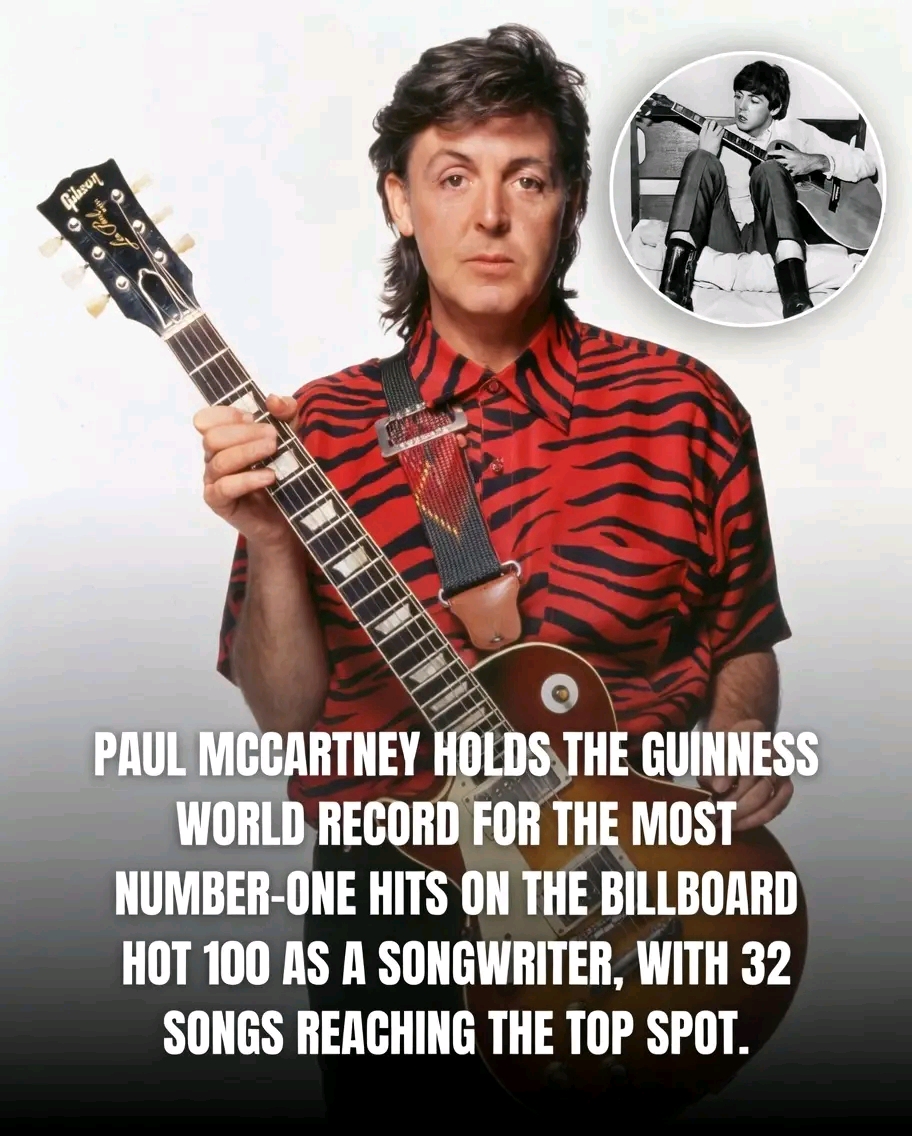
Statistically, his achievements are staggering. With 32 number-one hits on the Billboard Hot 100 as a songwriter, McCartney holds a Guinness World Records distinction that reflects not just popularity, but consistency at the highest level. Yet numbers alone cannot capture his true impact.
McCartney’s music has become a shared language. His songs have played at weddings, echoed through stadiums, comforted people in solitude, and united crowds in unforgettable singalongs. Generations who were born decades apart still find meaning in the same melodies—a rare and powerful testament to timeless artistry.
In an industry that constantly reinvents itself, McCartney remains both a pioneer and a constant. He didn’t just follow trends—he created them. And in doing so, he built a legacy that extends far beyond records and accolades.
Because in the end, Paul McCartney didn’t just make music.
He made memories.
And those memories continue to sing.