Capitol Passed. Beatlemania Didn’t.
How fan pressure forced America’s biggest label to surrender—and why January 20, 1964 changed everything.
At first, Capitol Records said no. Again and again.
The Beatles were already exploding in Britain, but in the United States, the country’s most powerful label dismissed them as just another overseas fad. Capitol executives heard the early singles—“Love Me Do,” “Please Please Me”—and shrugged. Guitar groups, they believed, didn’t sell in America. Rock and roll was supposedly on its way out. Teen screams were not a business strategy.
But Beatlemania didn’t care about boardroom logic.
While Capitol hesitated, something unusual began happening at ground level. American teenagers—especially on the East Coast—were discovering The Beatles through imported records, radio DJs who took risks, and word of mouth that spread faster than any marketing plan. Fans started requesting Beatles songs nonstop. Local stations reported phone lines jammed. Independent labels like Vee-Jay and Swan released Beatles singles, and despite weak promotion, the response was impossible to ignore.
The demand was real. Capitol’s resistance wasn’t.
By late 1963, the cracks showed. “I Want to Hold Your Hand” leaked into U.S. radio before its official release and immediately detonated. Stations that played it saw instant spikes in listenership. Teenagers weren’t just asking for the song—they were insisting on it. Capitol finally realized what it had misread: this wasn’t just music popularity. It was a cultural wave already in motion.
So Capitol reversed course.
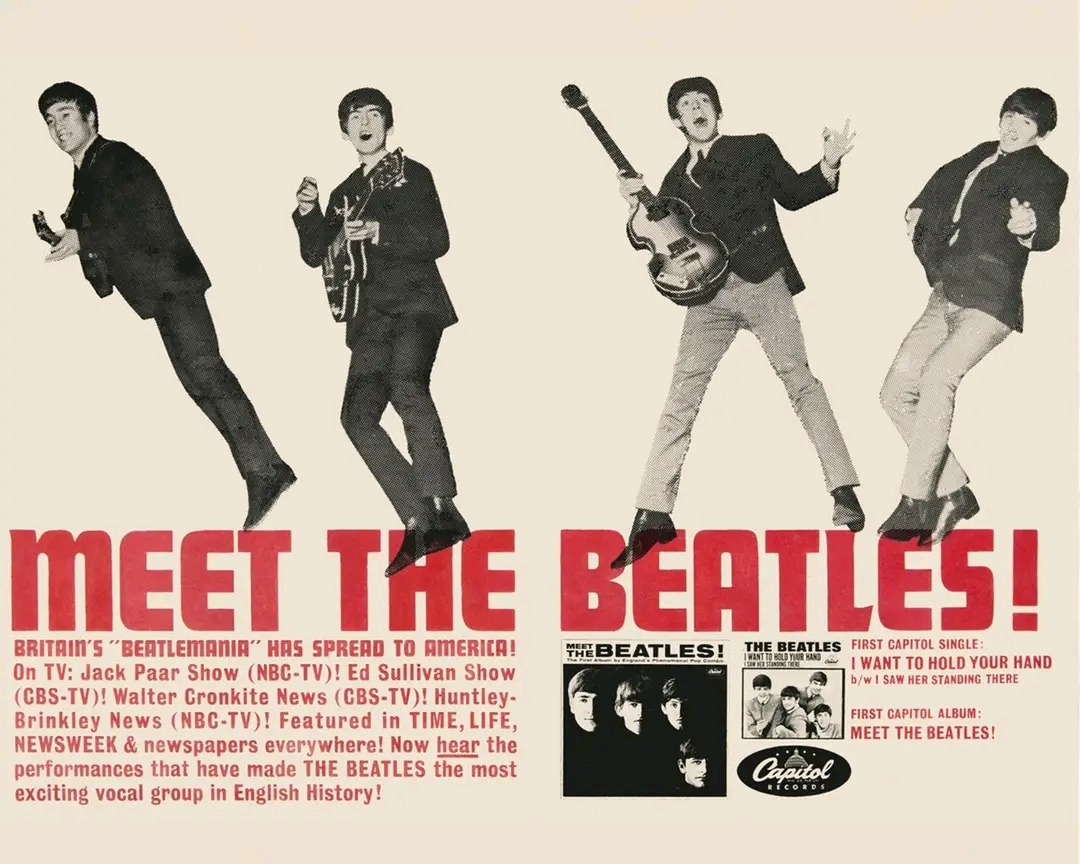
On January 20, 1964, Meet The Beatles! arrived in American record stores. The album wasn’t just a release—it was a declaration. With its bold black-and-white cover, stark presentation, and hit-heavy tracklist tailored specifically for the U.S. market, Capitol positioned The Beatles not as a novelty, but as the moment. Within weeks, the album shot to No. 1, replacing the Meet The Beatles! frenzy with something even bigger: total saturation.
Radio, television, fashion, language—everything tilted.
And Capitol, the label that once passed, now raced to keep up.
What makes Meet The Beatles! historic isn’t just its sales or chart position. It represents a rare turning point where fan demand overpowered industry skepticism. The gatekeepers said no. The audience said yes. Loudly. Repeatedly. Unstoppably.
By the time The Beatles landed in America and appeared on The Ed Sullivan Show in February, the battle was already over. Capitol hadn’t created Beatlemania—it had finally surrendered to it.
January 20, 1964 stands as the day America didn’t just accept The Beatles.
It caught up with them.
Capitol passed.
Beatlemania didn’t.