Before John Lennon Left The Beatles, He Did This First
In December 1968—at the exact moment when The Beatles were publicly releasing The White Album and privately drifting apart—John Lennon stepped onto a stage without the band that had defined his life. It was quiet. Unannounced. Almost deliberately small. And for nearly 30 years, most fans never saw it.
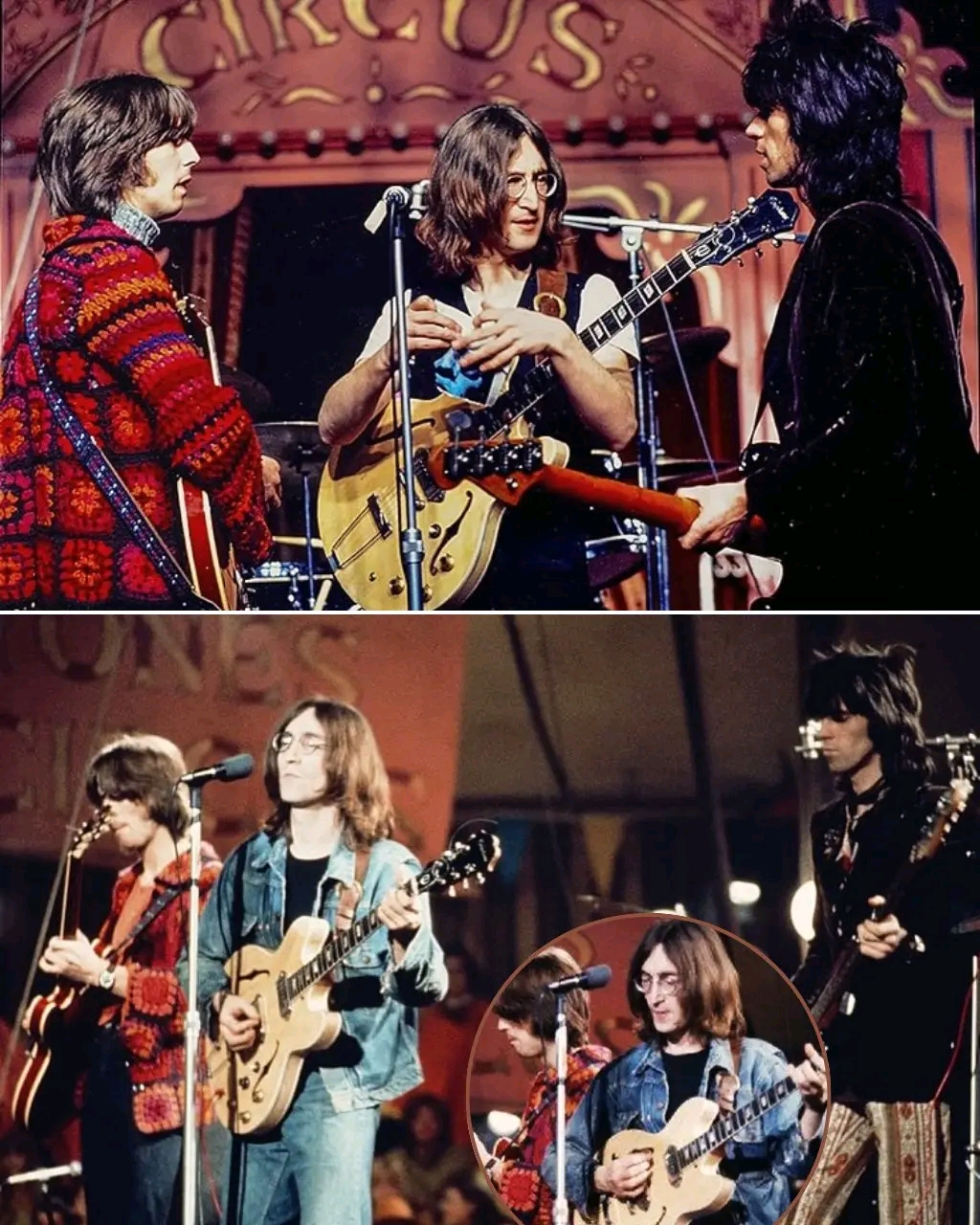
The performance took place during The Rolling Stones Rock and Roll Circus, a television special filmed in London but shelved until the mid-1990s. Lennon didn’t appear as a Beatle. Instead, he formed a one-off group called The Dirty Mac—a supergroup in spirit, but raw in execution. On guitar stood Eric Clapton, then at the height of his powers. On bass was Keith Richards, loosening his grip on his usual swagger. On drums, Mitch Mitchell of The Jimi Hendrix Experience. And at the center, gripping the microphone with visible intensity, was John Lennon.
Paul McCartney was not there.
That absence—once overlooked—has since become one of the most quietly discussed details in Beatles history.
A Performance That Felt Like a Statement
Lennon chose to perform “Yer Blues.” That choice was not accidental.
Written in India earlier in 1968, “Yer Blues” was Lennon at his most confessional—claustrophobic, sarcastic, and emotionally unfiltered. Unlike the psychedelic expansiveness often associated with the era, the song collapses inward. “Yes I’m lonely, wanna die,” Lennon sings—not as theater, but as confrontation.
On that stage, backed by musicians who were not Beatles, the song sounded different. Heavier. Stripped of harmony. Free of compromise.
This was not John Lennon experimenting for fun. It was John Lennon testing something.
The First Time John Stepped Out Alone
By late 1968, tensions inside The Beatles were no longer subtle. Creative disagreements, business pressures, and personal distance—especially between Lennon and McCartney—had hardened into something structural. Yet publicly, the band still existed. Contracts remained. Expectations remained.
What Lennon did at Rock and Roll Circus was unprecedented:
He performed as himself, not as one quarter of a democratic unit.
There was no Lennon–McCartney balance. No shared spotlight. No musical negotiation.
Just John.
Fans who’ve studied the footage often note how alive he looks—nervous, yes, but energized. He leans into the mic, eyes sharp, voice biting. When the song ends, he lets out a spontaneous, almost boyish “Rock and roll, circus!” It feels like relief.
As if he’d proven something to himself.
The Silence Where Paul Should Have Been
Paul McCartney’s absence that night wasn’t dramatic. There was no public fallout. No angry quotes. But history has taught fans that Beatles fractures rarely announced themselves loudly. They revealed themselves in who didn’t show up.
McCartney was still deeply committed to The Beatles as a working band in 1968. Lennon, increasingly, was not.
That empty space on stage—where Paul might have stood—now reads as symbolic. Not of hostility, but of divergence. Two men moving toward different futures at different speeds.
Lennon wasn’t leaving yet. But he was rehearsing the idea.
Why It Took 30 Years to Be Seen
The Rock and Roll Circus never aired in 1968. Mick Jagger reportedly felt the Rolling Stones were upstaged—particularly by The Who and Lennon’s ferocious performance. The footage was locked away, turning what might have been a headline moment into a historical secret.
When it finally surfaced in the 1990s, Beatles fans watched with new eyes.
By then, Lennon was gone. The breakup was long understood. And suddenly, here was proof—not of the end, but of the beginning of the end.
Not the Breakup—But the First Door Opened
John Lennon wouldn’t officially leave The Beatles until 1969. He wouldn’t announce it until later. But on that December night in 1968, he crossed a line that mattered deeply to him.
He stood on stage without Paul McCartney.
He sang a song that exposed his inner fracture.
He discovered he could do it—and survive.
History often looks for explosions. But this moment was a whisper.
And sometimes, whispers tell the truth long before anyone is ready to hear it.