The Hidden Tension Behind A Hard Day’s Night
Everyone remembers the opening train sequence of A Hard Day’s Night as pure, effortless cool.
Four young musicians running from screaming fans. Laughing. Joking. Leaping into a train carriage like the whole world belonged to them.
It feels spontaneous — almost documentary-real.
But according to John Lennon, it wasn’t effortless at all.
—
March 2, 1964 — The Day It Was Filmed
On March 2, 1964, filming began around London’s Marylebone area, capturing what would become one of the most iconic openings in music-film history. Under the direction of Richard Lester, the band were encouraged to act naturally — to be themselves.
Yet Lennon later admitted they were anything but relaxed.
He said they were “dead conscious” of every movement. Instead of loose camaraderie, there was hyper-awareness. Each glance, each laugh, each reaction was monitored. They were watching one another closely — so closely that it nearly made performing simple scenes difficult.
Why?
Because by early 1964, Beatlemania had exploded. The pressure was enormous. They weren’t just four friends in a band anymore — they were a global phenomenon being carefully managed and observed from every angle.
Even when pretending to be carefree on a train, they knew the world was watching.
—
The Quiet Beginning of a Decade-Defining Romance
That same day, something else happened — something far less obvious on screen.
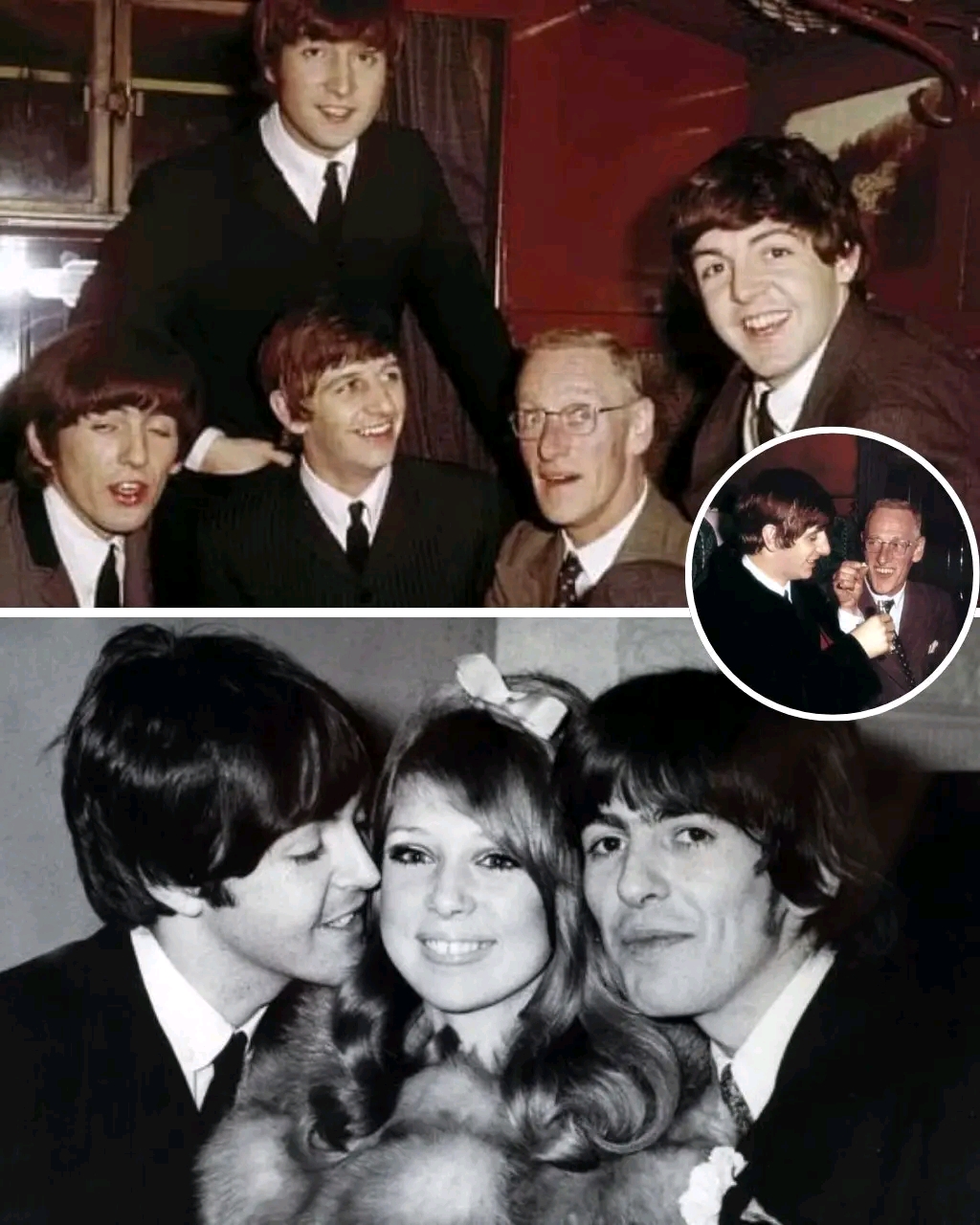
During the train scenes, George Harrison met a young model cast as a schoolgirl extra: Pattie Boyd.
To most viewers, she was simply another face in the carriage.
To Harrison, she became everything.
Their meeting sparked a romance that would define much of the decade. Boyd would later inspire some of his most celebrated songs and, after their marriage ended, would become central to one of rock’s most famous love triangles involving Eric Clapton.
But on March 2, 1964, it was just a brief exchange on a crowded film set — a small moment tucked inside cinematic history.
—
The Detail Most People Miss
Rewatch the train sequence carefully.
Look beyond the smiles.
You’ll notice how tightly grouped they are. How often they glance sideways at one another. How the humor feels slightly heightened — almost performed rather than lived. There’s a subtle stiffness beneath the charm.
They weren’t falling apart in a dramatic sense — not yet. But there was already a growing awareness of image, expectation, and pressure.
The detail most people miss isn’t a prop or a background extra.
It’s the tension in their eyes.
That tension hints at something bigger: the beginning of a shift. The moment when being “The Beatles” started to feel different from simply being friends in a band.
—
Effortless — or Carefully Controlled?
The genius of A Hard Day’s Night is that it hides all of this.
It captures lightning in a bottle — youth, humor, speed, chaos. It makes fame look playful. It makes pressure look fun.
But underneath that black-and-white sparkle was a group of young men adjusting to a world that had changed overnight.
The train scene still feels timeless.
Yet knowing what Lennon later revealed gives it a new layer — one where the laughter is real, but the awareness is sharper than we ever realized.
And maybe that’s what makes it even more compelling.
Because sometimes the coolest moments in history aren’t effortless at all.
They’re carefully held together — just long enough for the camera to roll.