The Legacy of Abbey Road and That Iconic Cover
In September 1969, The Beatles released what would become one of the most celebrated albums in music history. Though tensions were quietly pulling the band apart, Abbey Road emerged not as a fractured farewell—but as a masterwork. It was polished, ambitious, and emotionally layered. More than five decades later, its songs still echo across generations, and its cover remains one of the most imitated images in pop culture.
A Masterpiece Born at the End
By the time recording began, relationships within the band were strained. The failed Get Back sessions had left scars, and each member was increasingly pursuing personal creative paths. Yet when they reunited under producer George Martin, something remarkable happened: they agreed to make one final album “the way we used to.”
The result was musical brilliance.
From the soulful optimism of “Here Comes the Sun,” written by George Harrison, to the emotional depth of “Something,” the album showcased Harrison’s rising songwriting power. Meanwhile, John Lennon delivered raw edge in “Come Together,” and Paul McCartney crafted the ambitious medley that closes Side Two—a seamless suite of short songs woven into one grand finale.
That medley, ending with “The End,” feels almost prophetic. As voices harmonize, the line rings out: “And in the end, the love you take is equal to the love you make.” It sounds less like a lyric and more like a farewell.
The Simplicity of an Icon
While the music was groundbreaking, the cover was revolutionary in its simplicity.
No band name.
No album title.
No elaborate design.
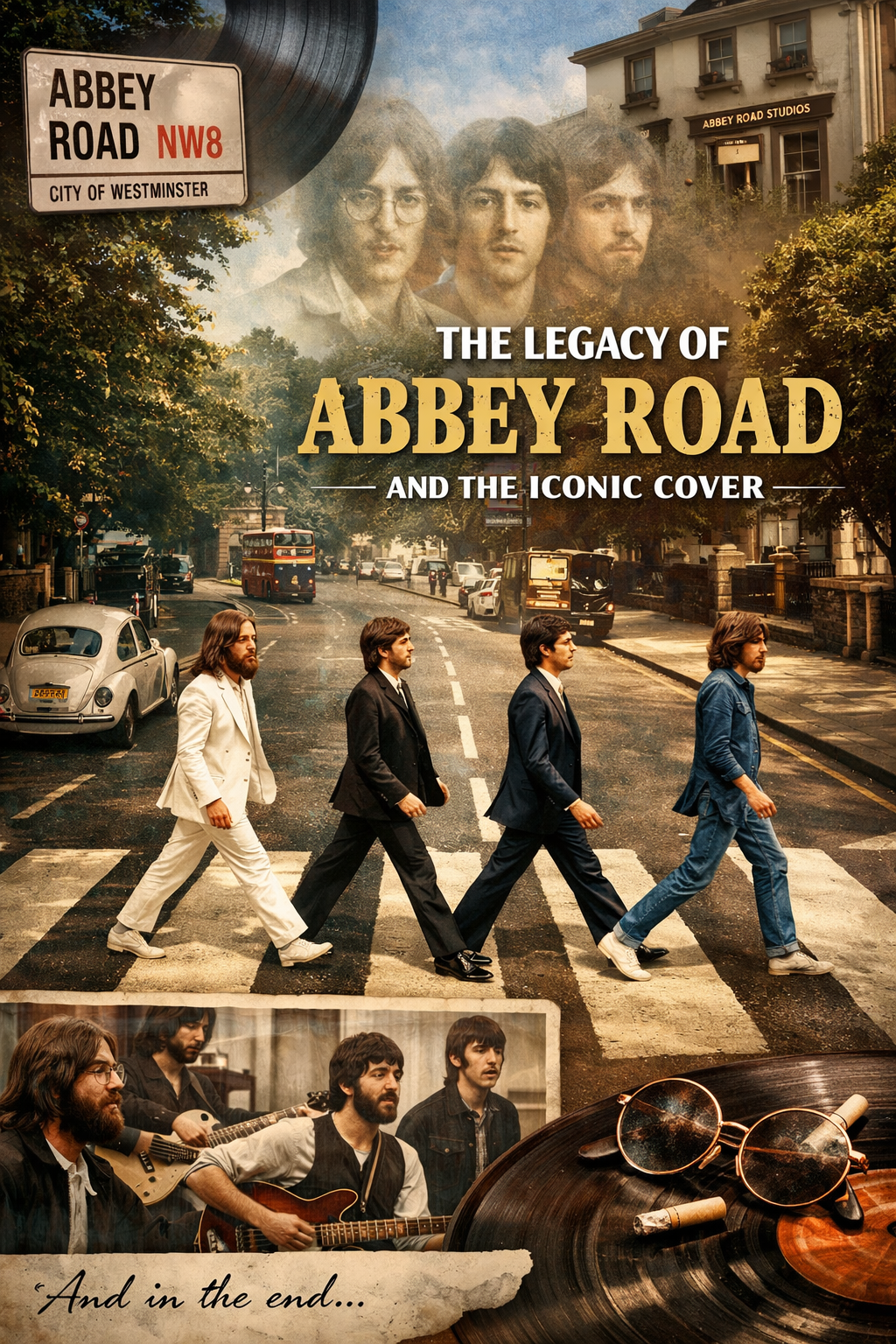
Just four men walking across a zebra crossing outside Abbey Road Studios in London.
Photographed by Iain Macmillan on August 8, 1969, the image was captured in just minutes as traffic was briefly halted. The band stepped across the street several times while Macmillan stood on a ladder in the middle of the road. One of those shots became history.
The image is powerful because it feels ordinary. Four figures in single file. Calm. Unposed. Moving forward.
Yet fans quickly found symbolism in every detail—sparking the famous “Paul is dead” conspiracy theory, analyzing bare feet, cigarette placement, and walking order. Whether coincidence or imagination, the myths only deepened the album’s mystique.
A Cultural Landmark
Today, the zebra crossing itself is a global pilgrimage site. Fans from around the world visit Abbey Road to recreate the walk, stopping traffic just as The Beatles once did. The crossing has even been granted protected status in the UK due to its cultural importance.
Few album covers have achieved this level of recognition. It transcends music. It is art, tourism, nostalgia, and identity—all in one frame.
The Sound of a Goodbye
Though Abbey Road was not the last album released by The Beatles, it was the last one they recorded together. In hindsight, it feels like a carefully constructed curtain call. The production is lush, the harmonies tight, and the songwriting confident. There is no sense of collapse—only creative triumph.
It represents maturity. Unity in the midst of fracture. Beauty created despite personal distance.
And perhaps that is why it endures.
Why the Legacy Still Matters
More than fifty years later, Abbey Road remains a benchmark for what a studio album can be. Artists still cite it as inspiration. Producers study its layered arrangements. Fans continue to discover it for the first time.
But its legacy goes beyond charts and awards.
It symbolizes transition—the end of the 1960s, the closing chapter of the world’s most influential band, and the moment when four young men from Liverpool walked forward into separate futures.
Yet frozen in that single photograph, they are forever together—mid-stride, timeless.
And in the end, that image may be just as powerful as the music itself.