George Harrison Wrote a Beatles-Level Masterpiece — and They Kept Saying No
In the towering mythology of The Beatles, there are countless stories of genius, conflict, and songs that changed the world. But few stories are as quietly heartbreaking as the journey of “Isn’t It a Pity.”
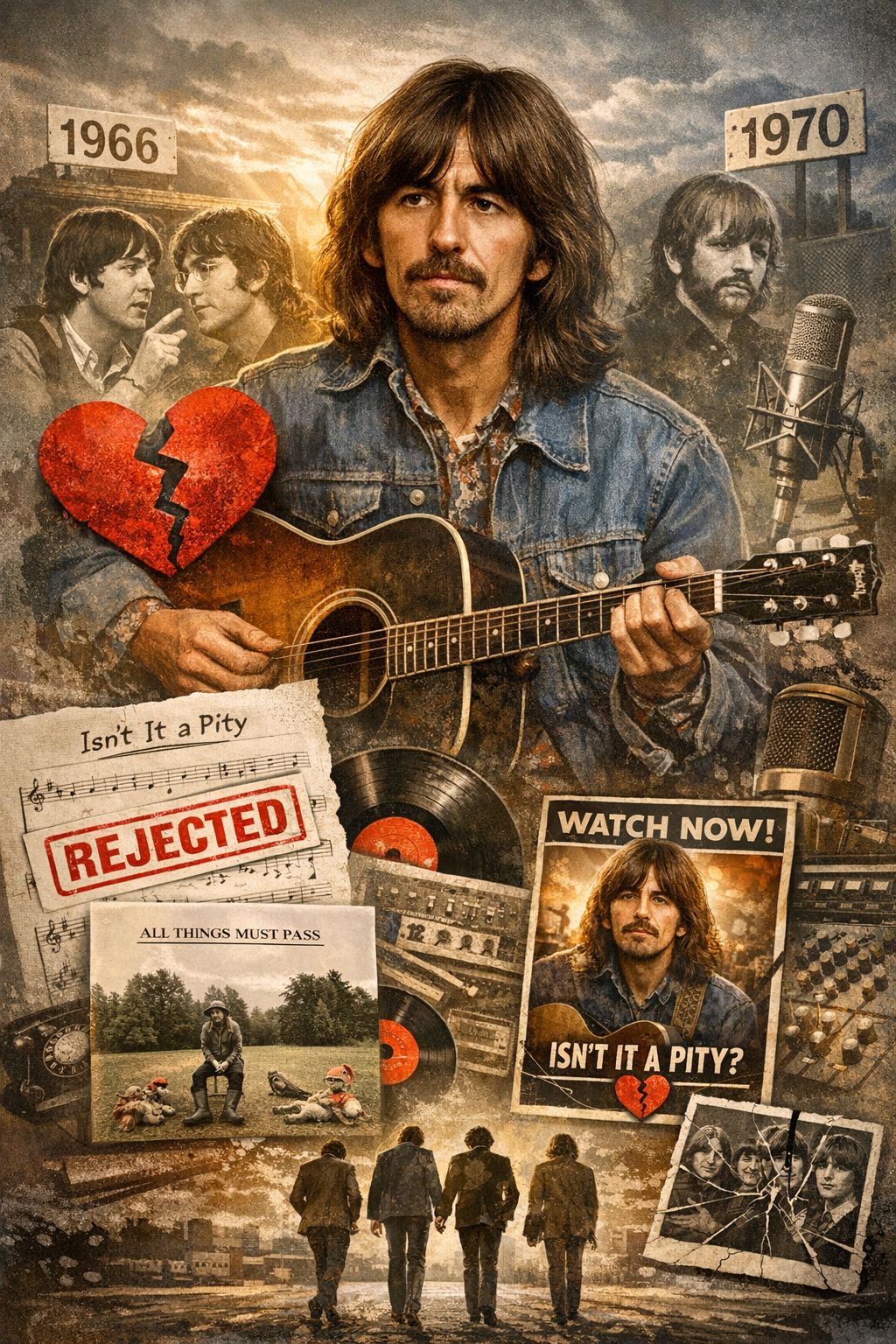
Written by George Harrison in 1966, the song would go on to become one of the most emotionally devastating compositions associated with the Beatles—even though the band never recorded it.
For years, Harrison brought the song to Beatles sessions. For years, it was turned down.
And when it was finally released in 1970, it did more than prove its worth.
It revealed just how much music George had been holding inside—waiting to be heard.
—
A Song Born in the Shadows of Lennon–McCartney
By 1966, George Harrison was no longer just “the quiet Beatle.” He had already written “If I Needed Someone,” “Taxman,” and “Love You To,” signaling a songwriter with his own voice and emotional depth.
It was during this period that George wrote “Isn’t It a Pity.”
The song wasn’t flashy. It wasn’t political. It didn’t chase trends.
Instead, it asked a simple, devastating question:
Isn’t it a pity how we break each other’s hearts?
George later explained that the song was about human relationships—how people fail to communicate, how love is wasted, how pride and ego destroy what could have been beautiful. It was universal, spiritual, and painfully honest.
Yet when Harrison brought it to The Beatles, it didn’t make the cut.
—
Why Did The Beatles Say No?
The rejection of “Isn’t It a Pity” wasn’t about the song being weak.
It was about timing, power, and hierarchy.
By the mid-to-late 1960s, The Beatles were still operating under an unspoken rule: Lennon–McCartney came first. Albums typically allowed space for only one or two George songs—if that.
Paul McCartney later suggested that the song may have felt “too slow” or “too repetitive.” Others believed it simply didn’t fit the direction of albums like Revolver or Sgt. Pepper.
But beneath the surface, something deeper was happening.
George Harrison was growing.
And The Beatles, as a unit, were struggling to make room for that growth.
—
A Song That Aged — While The Band Fell Apart
By 1969, tensions inside The Beatles were impossible to ignore.
George’s frustration was evident during the Let It Be sessions, captured on film as he struggled to have his ideas taken seriously.
Ironically, “Isn’t It a Pity” had aged perfectly into that moment.
What once sounded like a general meditation on human failure now felt like a direct reflection of The Beatles themselves—four men who loved each other, yet couldn’t stop hurting one another.
When the band finally broke up in 1970, George carried the song with him.
And this time, no one could say no.
—
All Things Must Pass — And So Did the Doubt
George recorded “Isn’t It a Pity” for his triple-album solo debut, All Things Must Pass.
Produced by Phil Spector, the song was released in two versions, both lush, emotional, and grand.
It became one of the album’s centerpieces.
Critics praised it. Fans embraced it. And suddenly, the song The Beatles had passed on sounded like one of the greatest songs they never recorded.
The irony was impossible to ignore.
George Harrison, once limited to a couple of tracks per album, had unleashed a flood of creativity that rivaled—and in some eyes surpassed—his former bandmates.
—
What George Really Meant
Despite speculation, George insisted that “Isn’t It a Pity” wasn’t written about The Beatles specifically.
But art has a way of revealing truths beyond intention.
By the time the song was released, it felt like a gentle eulogy—not just for a band, but for lost understanding, broken friendships, and the cost of ego.
It wasn’t angry.
It wasn’t bitter.
It was sad.
And that made it even more powerful.
—
The Masterpiece They Let Go
Today, “Isn’t It a Pity” stands as one of George Harrison’s defining works—a reminder that brilliance doesn’t always get recognized in its moment.
The Beatles didn’t reject the song because it lacked greatness.
They rejected it because they couldn’t hear it clearly yet.
By the time the world finally did, The Beatles were already gone.
And all that was left was the question George had asked years earlier: